

Master 2025 Latest The Questions F5 Networks Certification Study Materials and Pass 201 Real Exam!
Penetration testers simulate 201 exam PDF
F5 201 certification exam covers a broad range of topics, including basic networking concepts, TCP/IP fundamentals, F5 BIG-IP LTM system setup, configuration, troubleshooting, and management. 201 exam is designed to test the candidate's ability to work with F5 BIG-IP LTM systems, including installing, configuring, managing, and troubleshooting F5 BIG-IP LTM systems. BIG-IP Administrator Exam certification is valuable for professionals who work with F5 technologies and want to advance their careers in the IT industry.
F5 201 (BIG-IP Administrator) Certification Exam is an essential step for professionals who want to demonstrate their expertise in managing and maintaining F5 BIG-IP products and solutions. BIG-IP Administrator Exam certification is recognized globally and is a valuable asset for professionals who want to advance their careers in network and application services, security, and system management. Candidates are advised to prepare thoroughly for the exam using study materials and practice tests to increase their chances of success.
F5 201 (BIG-IP Administrator) Certification Exam is a valuable certification for IT professionals who want to enhance their skills in application delivery networking and security. BIG-IP Administrator Exam certification exam validates the knowledge and skills required to effectively deploy, configure, and manage F5 BIG-IP products in complex network environments. Earning this certification can lead to career advancement opportunities and demonstrates a commitment to professional development.
NEW QUESTION # 12
A site wishes to perform source address translation on packets from some clients but not others. The determination is not based on the client's IP address, but on the virtual servers their packets arrive on. What could best accomplish this goal?
- A. Some virtual servers could be associated with SNAT pools and others not associated with SNAT pools.
- B. A SNAT for all addresses could be defined, and then disable the SNAT processing for select VLANs.
- C. The decision to perform source address translation is always based on a client's address (or network). Thus, this goal cannot be achieved.
- D. The decision to perform source address translation is always based on VLAN. Thus, the goal cannot be achieved.
Answer: A
NEW QUESTION # 13
A BIG-IP Administrator must determine if a Virtual Address is configured to fail over to the standby member of a device group in which area of the Configuration Utility can this be confirmed?
- A. Device Management > Devices
- B. Device Management > Traffic Groups
- C. Device Management > Overview
- D. Local Traffic > Virtual Servers
Answer: D
NEW QUESTION # 14
You need to terminate client SSL traffic at the BIG-IP and also to persist client traffic to the same pool member based on a BIG IP supplied cookie.
Which four are profiles that would normally be included in the virtual server's definition? (Choose four.)
- A. ServerSSL
- B. CookieBased Persistence
- C. HTTPS
- D. TCP
- E. HTTP
- F. ClientSSL
Answer: B,D,E,F
NEW QUESTION # 15
Which two statements are true about SNATs? (Choose two.)
- A. SNATs can be configured within a Profile definition.
- B. SNAT's are enabled only on the VLAN where origin traffic arrives, by default.
- C. SNATs are enabled on all VLANs, by default.
- D. SNATs can be configured within a Virtual Server definition.
Answer: C,D
NEW QUESTION # 16
Refer to the exhibit.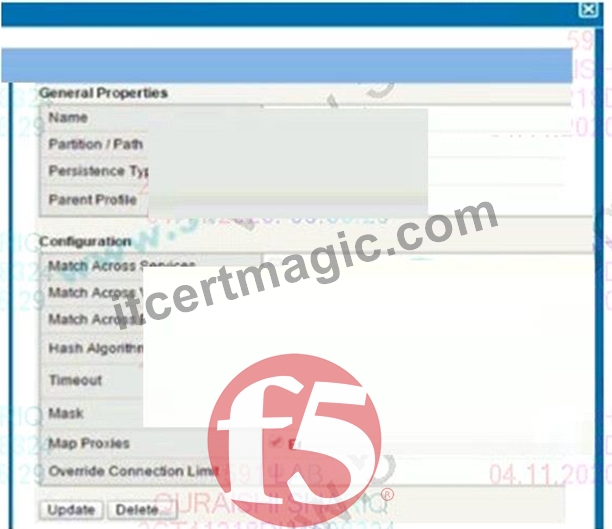
How long will the persistence record remain in the table?
- A. 180 seconds after the initial table entry
- B. 300 seconds after the last packet
- C. 180 seconds after the last packet
- D. 300 seconds after the initial table entry
Answer: B
NEW QUESTION # 17
Assume a virtual server is configured with a ClientSSL profile. What would the result be if the virtual server's destination port were not 443?
- A. Since the virtual server is associated with a ClientSSL profile, it will always process traffic sent to port 443.
- B. SSL termination could not be performed if the virtual server's port was not port 443.
- C. As long as client traffic was directed to the alternate port, the virtual server would work as intended.
- D. Virtual servers with a ClientSSL profile are always configured with a destination port of 443.
Answer: C
NEW QUESTION # 18
A custom HTTP monitor is failing to a pool member 10.10.3.75:8080 that serves up www.example.com.
A ping works to the pool member address.
The SEND string that the monitor is using is: GET/HTTP/l.l/r/n/Host.www.example.com/r/n/Connection Close/r/n/r/n Which CLI tool syntax will show that the web server returns the correct HTTP response?
- A. tracepath 'http://www.example.com:80
- B. curlhttp://10.10.10.3.75:8080/www.example.com/index.html
- C. curl-header 'Host:www.example.com'
http://10.10.3.75:8080/ - D. tracepath 10.10.3.75:8080 GET /index
Answer: C
NEW QUESTION # 19
A BIG-IP Administrator has configured a BIG-IP cluster with remote user authentication against dcOl f5trn.com. Only local users can successfully log into the system. Configsync is also failing.
Which two tools should the 8IG-IP Administrator use to further investigate these issues? (Choose two)
- A. pwck
- B. ntpq
- C. passwd
- D. dig
- E. pam_timestamp_check
Answer: B,C
NEW QUESTION # 20
A virtual server is listening at 10.10.1.100:any and has the following iRule associated with it: when CLIENT_ACCEPTED { if {[TCP::local_port] equals 80 } { pool pool1 } elseif {[TCP::local_port] equals 443 } { pool pool2 } If a user connects to 10.10.1.100 and port 22, which pool will receive the request.
- A. pool1
- B. None. The request will be dropped.
- C. pool2
- D. Unknown. The pool cannot be determined from the information provided.
Answer: D
NEW QUESTION # 21
A BIG-IP Administrator makes a configuration change to the BIG-IP device. Which file logs the message regarding the configuration change?
- A. /var/log/secure
- B. /var/log/audit
- C. /var/log/messages
- D. /var/log/user.log
Answer: B
Explanation:
Explanation
About audit logging
Audit logging is an optional feature that togs messages whenever a BIG-IP system object, such as a virtual server or a load balancing pool, is confined (that is. created, modified, or deleted). The BiGIP system logs the messages for these auditing events in the file /var/log'audit There are three ways that objects can be configured
* By user action
* By system action
* By loading configuration data
Whenever an object is configured in one of these ways, the BIG-IP system logs a message to the audit log
NEW QUESTION # 22
A site wishes to perform source address translation on packets arriving from the Internet for clients using some pools but not others. The determination is not based on the client's IP address, but on the pool they are load balanced to. What could best accomplish this goal.
- A. For each virtual server, regardless their default load balancing pools, association with SNAT pools could vary dependent upon need.
- B. A SNAT for all addresses could
be defined,
and then disable the SNAT processing for select pools. - C. The decision to perform source address translation is always based on a client's address (or network). Thus, this goal cannot be achieved.
- D. The decision to perform source address translation is always based on VLAN. Thus, the goal cannot be achieved.
Answer: B
NEW QUESTION # 23
The BIG-IP Administrator creates a custom iRule that fails to work as expected. Which F5 online resource should the administrator use to help resolve this issue?
- A. Bug Tracker
- B. DevCentral
- C. Health
- D. University
Answer: B
NEW QUESTION # 24
You have a pool of servers that need to be tested. All of the servers but one should be tested every 10 seconds, but one is slower and should only be tested every 20 seconds. How do you proceed?
- A. It can be done by assigning one monitor to the pool and a different monitor to the slower pool member.
- B. It cannot be done. All of the members of a pool must be tested at the same frequency.
- C. It can be done, but will require assigning monitors to each pool member.
- D. It cannot be done. All monitors test every five seconds.
Answer: A
NEW QUESTION # 25
A BIG-IP Administrator plans to upgrade a BIG-IP device to the latest TMOS version.
Which two tools could the administrator leverage to verify known issues for the target versions?
(Choose two.)
- A. F5 Bug Tracker
- B. FSiHealth
- C. F5 End User Diagnostics (EUD)
- D. F5 Downloads
- E. F5 University
Answer: A,B
Explanation:
Explanation
F5 University -- F5 learning materials
F5 Downloads - iso download page
F5 End User Diagnostics (EUD) -- Hardware detection
NEW QUESTION # 26
A BIG-IP Administrator explicitly creates a traffic group on a BIG-IP device.
Which two types of configuration objects can be associated with this traffic group? (Choose two.)
- A. VLANS
- B. Virtual Addresses
- C. Pool Members
- D. iRules
- E. Application Instances
Answer: B,E
NEW QUESTION # 27
......
Penetration testers simulate 201 exam: https://passitsure.itcertmagic.com/F5/real-201-exam-prep-dumps.html